In the past I have covered some topics on housing in more depth to show a more complex and less dire reality than what some others are portraying.
One example is where I showed Garth Turner's
model of a typical Canadian home buyer as exaggerated.
Another where I point out some inaccuracy regarding the systematic risk of the CMHC. (
here and
here)
In this post I will look at demographics and housing with this chart from the
Alberta Bubble Blog as a starting point.

The conclusion is pretty clear. An aging population will lead to lower economic activity and lower demand for housing. There are a couple of details to indicate a less severe impact than implied in this graphic.
First, look at how top heavy the age distribution of the chart. It's because lower birth rates as compared to the baby boom.
But there is more to the story. At the peak in 1960 there were
479,000 births while this chart shows
540,000 people at the peak age range of 45 (in 2006). Immigration has had a role to play here otherwise this age group would have decreased. Consider the components of population growth in this chart from
Statistics Canada.

Since immigration has made up a portion of population growth the pyramid will be skewed upwards. The portion of immigrants among the newborns only includes those who come to Canada within that year. In contrast those age 30 include immigrants who have come to Canada over the last 30 years at different ages.
The lower numbers represented among 0-15 age group compared to 16-30 years has more do do with immigration than declining birth rates. That is why I disagree with observation "D" in the chart
"2011 to 2026 will witness a sharp decrease in the 20 - 35 year old cohort". Statistics Canada
recently projected this age range will increase from 7.16 million in 2011 to 7.27 million in 2026. This was using their medium growth assumptions which I found to be totally reasonable.

I also disagree that demographics will necessarily result in an absolute drop in aggregate demand (housing or otherwise). It is true boomers represent the largest demographic and they are currently in their years of peak demand. This may be offset by a population that is still growing due to longer life expectancies, slightly higher birth rates and immigration.

One graphic used on the chart is the shift in housing demand over the next 15 years. It shows boomers will go from living alone in a 1800 sq ft single family home to assisted living space of 500 sq ft 15 years later. This definitely does not represent the group as a whole. For an alternative example consider 50 year old boomer parents with children in their late teens. They may have a house which is too big for them in 20-30 years when they require assisted living but their children will have formed households of their own long before then.
What else is not mentioned, but included in statistics Canada's current projections is an increase in the birth rate. Over the past year there were 381,000 births in Canada, compared to 338,000 in 2006. Surprisingly, this is only 20% fewer in absolute terms as the peak of the baby boom.
Finally, being this is an Albertan blog and all, I have to point out that
it's different here. Note the higher proportion of younger people and mini baby-boom.


 Sales were little changed in November compared to the previous month where normally a drop would be expected.

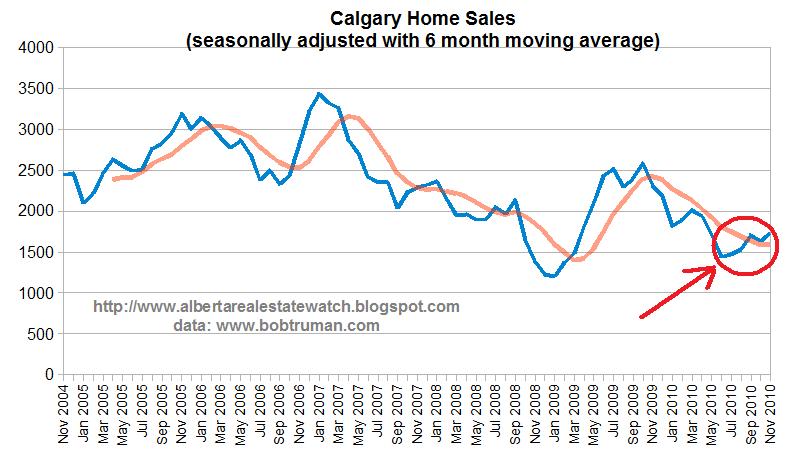 See the sales surge? Looking at a seasonally adjusted chart it's more like a modest bounce from depressed levels. Not a distressed market but not quite a robust one either.


